

Article summary
Keratoconus has no cure but treatment restores functional vision, tailored to disease stage. Over 90% of patients avoid surgery. Options include:
- Glasses or soft lenses for mild cases
- RGP, hybrid or scleral contact lenses for moderate keratoconus
- Corneal cross-linking to halt progression
- Corneal transplant, needed by under 5% of patients
Costs vary by treatment stage.
About keratoconus treatment
Keratoconus is a progressive eye condition in which the cornea gradually thins and takes on an irregular, cone-like shape. There is no cure, but with the right treatment plan the great majority of patients can achieve good functional vision throughout their lives. Dr. Jim Kokkinakis has been treating keratoconus at The Eye Practice in Sydney for over 30 years, and what follows is a comprehensive guide to every treatment option – from the simplest non-surgical approaches to the most advanced surgical techniques.
What is keratoconus and why does treatment matter?
Keratoconus affects roughly one in 375 Australians. It typically first appears in the late teens or early twenties, and in Australia there is particular concern around allergy-related chronic eye rubbing and UV exposure – both of which are associated with accelerating the condition’s progression. Avoiding eye rubbing is especially important for keratoconus patients. Also, Sydney’s high UV index makes sun protection essential.
The condition affects both eyes in most cases, though rarely to the same degree at the same time. Left untreated or poorly managed, it can progress to a point where even contact lenses no longer provide adequate vision, leaving surgery as the only remaining option. Early diagnosis and timely intervention are therefore critical – and that starts with seeing a keratoconus specialist who has both the diagnostic technology and the clinical experience to match treatment to the patient’s specific stage of disease.
Important
It’s important to note that keratoconus treatment is not a cure. Rather, it aims to restore clear vision.
Keratoconus treatment without surgery
The good news is that the overwhelming majority of keratoconus patients – over 90% – never need a corneal transplant, and most can be effectively managed without any surgery at all.
Glasses
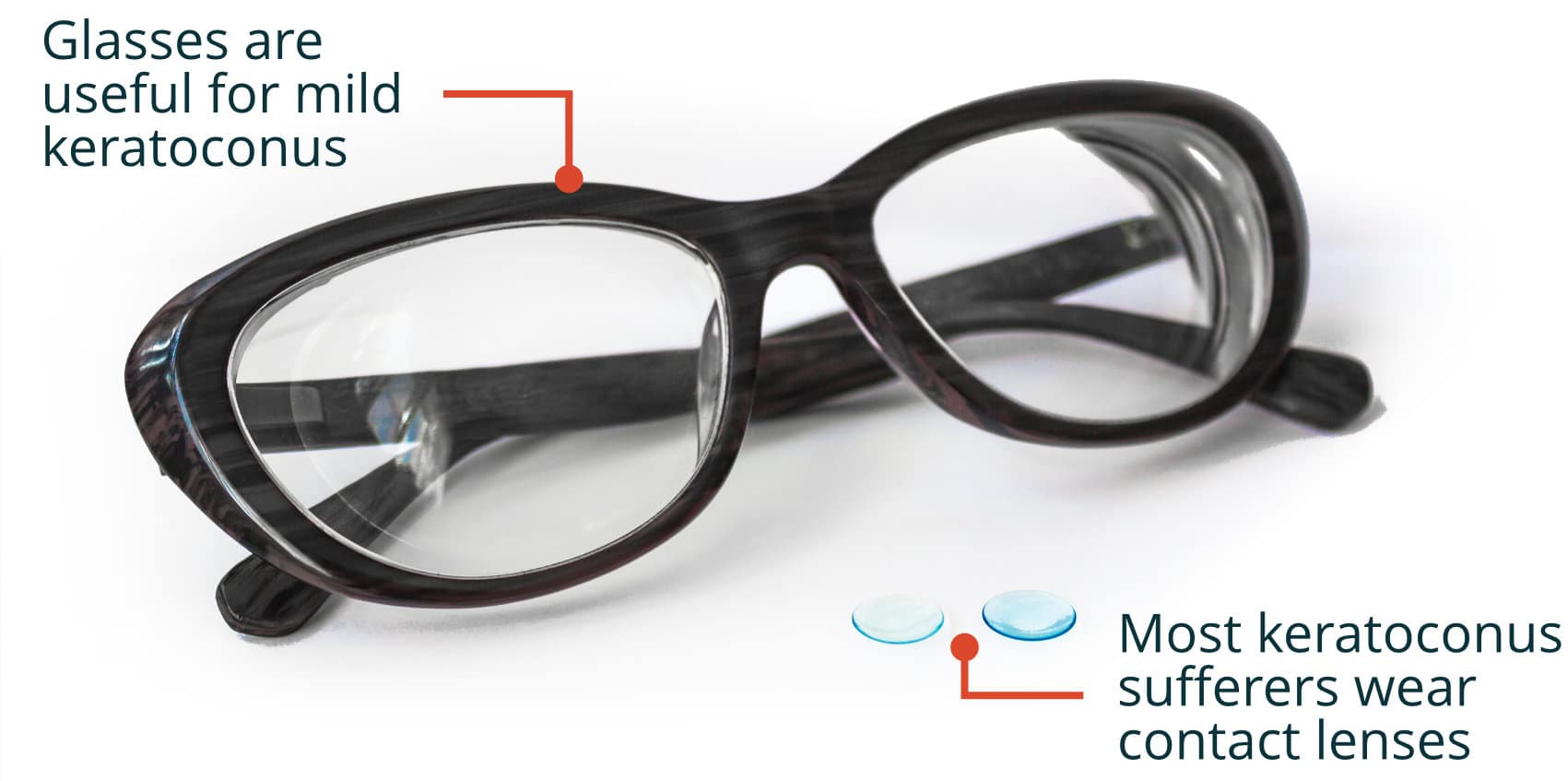
In the early stages of keratoconus, glasses often provide very serviceable vision. They work well when the irregular astigmatism is mild enough that a conventional spectacle prescription can compensate for it. As the cornea continues to distort, however, glasses progressively lose their effectiveness – at which point contact lenses become necessary.
Contact lenses for keratoconus
Contact lenses are the cornerstone of keratoconus treatment without surgery. The lens sits directly on or over the cornea, creating a smooth refracting surface that bypasses the cornea’s irregular shape. Different lens designs suit different stages and types of the condition.
Soft contact lenses work well in mild keratoconus where the corneal irregularity is still limited. They are comfortable and breathable, though they lack the rigidity to fully correct moderate-to-advanced distortion.
Rigid gas permeable (RGP) lenses are the most commonly prescribed contact lens for keratoconus. The rigid material vaults over the irregular corneal surface, and the tear film that forms beneath the lens effectively smooths out the distortion. RGP lenses can deliver significantly sharper vision than glasses or soft lenses in most keratoconus cases, and they remain the workhorse of non-surgical treatment.
Piggyback systems – a rigid lens worn over a soft lens – combine the optical precision of RGP lenses with the comfort of a cushioning soft lens underneath. Dr. Kokkinakis uses this approach when patients find conventional RGP lenses uncomfortable to wear for extended periods.
Hybrid contact lenses have a rigid central zone for optical correction and a soft peripheral skirt for comfort and stability. They are particularly practical for patients who are physically active.
Scleral contact lenses are large-diameter lenses that vault entirely over the cornea and rest on the white of the eye – the sclera. The fluid reservoir beneath the lens both corrects vision and protects the cornea from irritation. For patients with advanced keratoconus or those who struggle with conventional RGP lenses, sclerals are often the best non-surgical treatment available, and they have transformed the quality of life for many of Dr. Kokkinakis’s more challenging patients.
Surgical keratoconus treatment
Surgical options are considered when non-surgical management can no longer provide adequate vision, or when the condition is actively progressing and needs to be halted. In Australia, surgical options are generally performed by ophthalmologists, while the pre- and post-operative contact lens management – often the more complex and ongoing aspect of care – remains the domain of specialist optometrists like Dr. Kokkinakis.
Corneal collagen cross-linking
Corneal collagen cross-linking (CXL) is the most important advance in keratoconus treatment of the last two decades. It is a minimally invasive procedure that works by instilling riboflavin (vitamin B2) eye drops into the cornea, which are then activated by controlled ultraviolet-A light. This process creates new bonds between the collagen fibres that make up the corneal stroma, substantially strengthening the cornea and – in most cases – halting the progression of the disease.
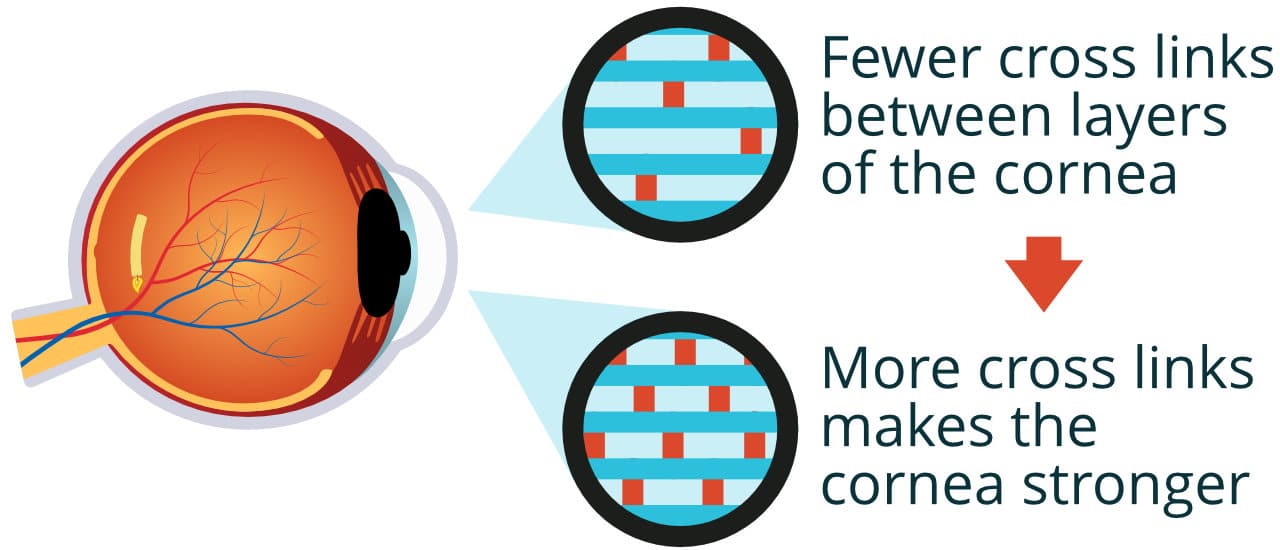
Cross-linking does not restore lost vision. Its primary purpose is to stabilise the cornea and prevent further deterioration. This is why timing matters: the procedure is most effective when performed during an active phase of progression, and it is far better to cross-link early than to wait until severe damage has occurred. Recovery from corneal cross-linking typically involves a few days of discomfort and light sensitivity, followed by several weeks during which vision may fluctuate before stabilising. Most patients can return to contact lens wear within four to eight weeks.
In Australia, cross-linking is available at ophthalmological clinics in Sydney and other major centres. The cost typically falls in the range of $1,500 – $3,000 per eye depending on the technique used and whether private health insurance provides a rebate.
Combined cross-linking and laser treatment
Some patients are candidates for a combined procedure in which corneal cross-linking is paired with a form of corneal laser treatment – typically topography-guided PRK (photorefractive keratectomy). The laser component aims to regularise the corneal surface and reduce some of the irregular astigmatism before cross-linking locks in the result. This approach is not appropriate for all patients and requires careful assessment, as keratoconus and conventional laser eye surgery (LASIK) do not mix well. A thorough pre-operative assessment by a specialist is essential.
Intraocular contact lenses (ICL)
Implantable collamer lenses are soft lenses surgically placed inside the eye, in front of the natural lens. They can be a useful option for keratoconus patients who struggle to tolerate contact lens wear on the ocular surface, though this is an invasive procedure and is not appropriate for patients with unstable or progressing disease. Cross-linking should generally be performed first.
Intacs (intracorneal ring segments)
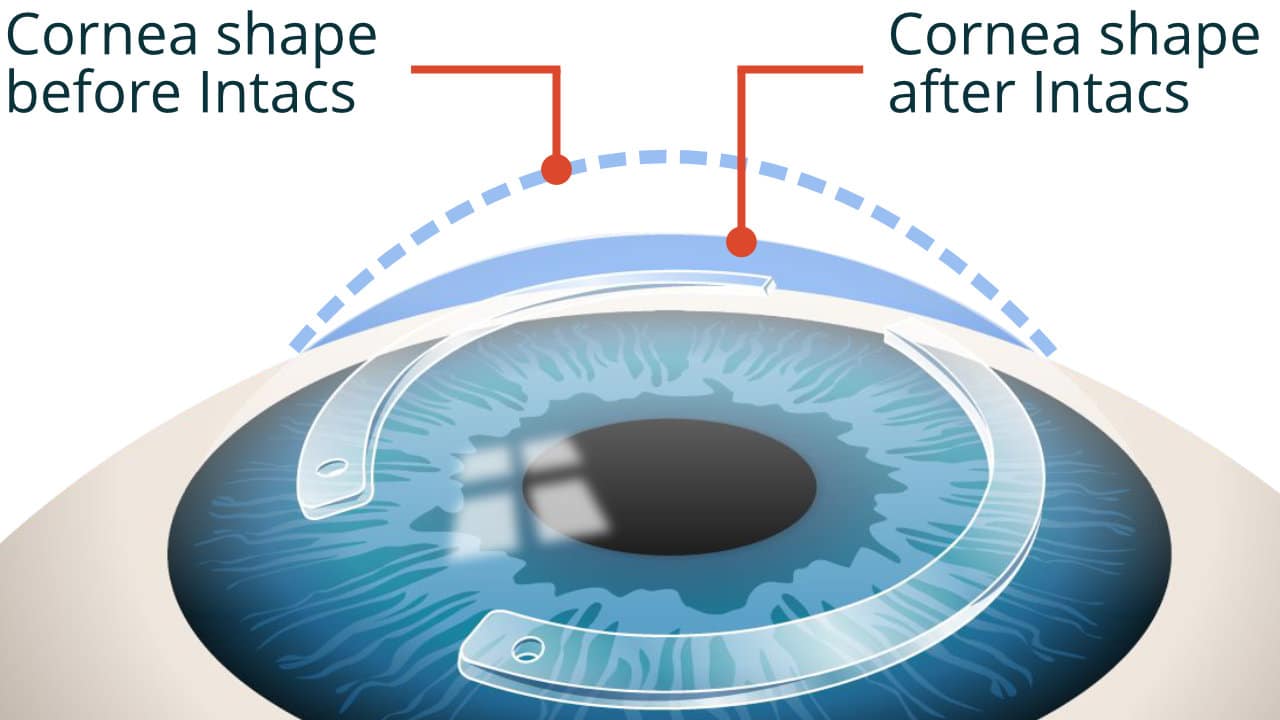
Intacs are small, arc-shaped plastic inserts placed within the corneal stroma to flatten and regularise the corneal surface. They can improve contact lens tolerance and, in some cases, visual acuity. Results have been variable, however – which is why they are not a first-line surgical option at The Eye Practice.
CAIRS – Corneal allogenic intrastromal ring segments
CAIRS is a minimally invasive keratoconus treatment that reshapes the cornea using small arcs of sterilised human donor tissue rather than synthetic plastic. This tissue-based approach is designed to offer a safer, more biocompatible alternative to traditional synthetic ring procedures such as Intacs.
Corneal transplant
A corneal transplant is reserved for cases where other treatments have failed to provide acceptable vision or contact lens comfort. Modern techniques – particularly deep anterior lamellar keratoplasty (DALK) – allow surgeons to replace the central layers of the cornea while preserving the patient’s own inner endothelial layer, reducing the risk of rejection. Importantly, a corneal transplant does not necessarily mean the end of contact lens wear – many post-transplant patients still need specialised lenses or glasses for optimal vision. Fewer than 5% of keratoconus patients ever reach the point where a corneal transplant is required.
Keratoconus treatment eye drops
There are currently no approved eye drops that treat keratoconus itself or slow its progression when used alone. The riboflavin drops used in cross-linking are a procedural component, not a standalone therapy. Research into pharmacological agents for keratoconus stabilisation is ongoing, and 2026 clinical trial data continues to expand the field’s understanding of new treatment possibilities, but no eye drop treatment has yet reached routine clinical use in Australia.
Keratoconus treatment cost in Australia
Costs vary considerably depending on the stage of the condition and the treatments required. In the early stages, glasses or standard soft contact lenses represent a modest ongoing expense. Custom rigid gas permeable or scleral contact lenses – including fitting and follow-up – typically cost in the range of $1,500 – $2,500 per eye. Surgical options such as cross-linking may attract a Medicare rebate in some circumstances, and private health insurance (hospital cover) can offset the costs of surgical procedures. Patients are advised to check their individual entitlements with their insurer before proceeding with any surgical referral.
Why choosing a keratoconus specialist matters
Keratoconus is not a condition that benefits from a generic approach. The disease is extraordinarily variable – no two patients are the same – and optimal management requires a specialist who has seen enough cases to recognise subtlety, and who has access to the technology needed to track it precisely over time.
Dr. Kokkinakis has been managing keratoconus at The Eye Practice in Sydney for over 30 years. He is a Fellow of the International Society of Contact Lens Specialists (ISCLS) and a Senior Lecturer at the UNSW Optometry School, where he teaches on the subject. Patients seen by Dr. Kokkinakis receive a bespoke treatment plan built around their particular corneas, their lifestyle, and their visual goals – not an off-the-shelf protocol.
For anyone who has been diagnosed with keratoconus, or who suspects their vision has been changing in ways that warrant investigation, an early comprehensive assessment at The Eye Practice is the best first step. The sooner the condition is properly understood, the more treatment options remain available.
About the Author: Dr Jim Kokkinakis

More information
Diagnosed with keratoconus from the age of 13
Living with keratoconus has its challenges, but with the right support, it is manageable.
Despite having keratoconus, I have lived life to the fullest
A diagnosis of Keratoconus was not the end of the world. It simply presented a challenge.
How contact lenses helped my keratoconus
Contact lenses have been a part of Helen's life for almost 50 years and she is so grateful to have them for her vision correction for keratoconus.
I could still design and sew beautiful gowns, even with keratoconus
Carol was diagnosed with keratoconus in the 1970's, yet she went on to design and sew spectacular evening gowns.

Living with keratoconus
Our patients share their stories of living with keratoconus. See how, with careful treatment, you can thrive in spite of keratoconus.

Keratoconus
Keratoconus is a condition that causes blurred vision and shortsightedness.